Birch

Updated: Feb 3
When we are stricken and cannot bear our lives any longer, then a tree has something to say to us.
Hermann Hesse
Once a year, at the peak of January’s greyness, I go to a soulless industrial estate to get my car MoT’d.
It’s miles from anywhere interesting, and, unless I want to shell-out for a taxi or stand for too long at a bus stop, I’m pretty much trapped there.
People in shiny suits in the car dealership try to sell me packages for what amount to car beauty-treatments and insist that I’m missing a wonderful opportunity to get on the first rung of a car ‘upgrade’ ladder. I often wish I was with an independent garage, but having been with this place a while now, entropy has set in. As the car ages, I suspect the deal I’m on becomes better value for money, and I might as well stick, despite the way the place makes me feel.
Outside the fluorescently lit dealership, litter blows around in the kind of drizzle that picks up and redistributes the grime. The damp wind randomly works itself up into a rage to slap and sting me in the face.
I see that the main road goes over a bridge and, for a second, even though I know full-well that it doesn't, I wonder if perhaps it goes over a stream. Pulling my hood up and keeping to the very inside lane of the pavement to avoid getting soaked by the cars speeding by at 50, I hang my head over the peeling railings and gaze, dismally, at the car park below. It’s lined up with multiple cars of the same type, all devoid of registration plates or personalities.
Coming to the same specific place every year could offer me an opportunity for what the recovery community would call a ‘check in.’ A review. Or, as some would say, an ‘inventory.’ It is, afterall, my sober anniversary in a couple of weeks time. Some recovery folk choose to go to a convention or a retreat to undertake this in-depth annual self-assessment. I used to do all those things much more formally than I do now, and they were crucial to the bedding-in of my recovery. The recovery community rightly warns of complacency, and I always weigh those warnings carefully, but as the decades have passed, I’ve found that if I remain committed to their spirit, I don’t need to hold on quite so tightly to the letter of those specific practices.
That said, I know, much to my cost, that I must consistently prioritise a commitment to deepening my understanding of the unconscious forces that drive me. I have to take responsibility for them and, ultimately, find ways of reshaping them for the better. But so long as that process is always ongoing, I’m comfortable that I can take different routes. In fact, I think it is important that I do. If nothing changes, nothing changes. Without letting go of anything I’ve learned, I should push on and explore beyond the circumference of that priceless repository of recovery wisdom. I should be prepared to challenge myself in new, and perhaps deeper, ways.
I do not, for a moment, think of this "MoT day" as an opportunity for a recovery review. For one thing, such a review should focus on behaviour, on one’s treatment of others, rather than on the softer, self-involved notion of how one ‘feels’.
“How you ‘feel’ is just weather.”
I can hear, in my head, the voice of a much-loved, strict but kindly, long-sober recovery ‘old-timer’.
However, wandering aimlessly in the drizzle, I can’t help but naturally reflect on the relationship between how I ‘feel’ today and how I felt this time last year, the year before, the year before that, and so on. Perhaps why this comes so readily to mind, is that the bleakness of the place and the experience of being trapped here, makes me feel a little bit low, and there is something in the quality of feeling low that opens a door to difficult memories.
I shove my hands into my pockets and walk on, away from the bridge near the car dealerships and miscellaneous warehouses, and into a slightly more residential area. Still bleak and grey. Here, there are terraced houses, probably multi-occupancy despite their small size, the terrace ends dwarfed by large billboards. Frayed posters advertising Sky TV programmes from last year flap in the wind. Weeds grow from dripping guttering, and up between broken paving-slabs. There’s a vape shop, a tanning shop, and pavement bin, full to the point of bursting, litter swirling around it.
And then I see it.
I had forgotten it was here.
A solitary weeping silver birch, growing at the side of a pot-holed drive.
It doesn’t lift my heart. It’s grey, like everything else. And weeping. But I have noticed it every year.
“Hello, old friend,” I say. “You still here?”
It rustles in the breeze, waving its weeping branches. If I’m not mistaken, there’s a touch of burgundy underneath the greyness of the fronds. It’s an understated burgundy aura, just an impression. I don’t know where that’s coming from, bark or foliage. Or perhaps from somewhere else entirely. I smile cynically at my instinctive leap to the otherworldly.
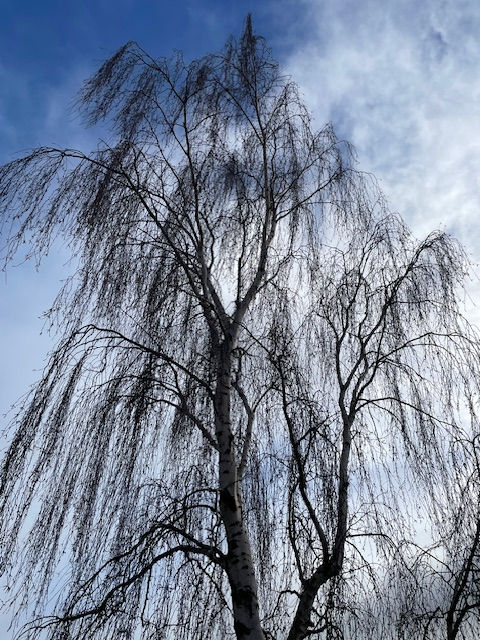
Like any other silver birch, its trunk is a luminous light grey, almost white, a colour that looks, frankly, wrong for a tree. I guess a weeping silver birch is a kind of suburban ornamental tree. I think of the pampas grass growing on the roundabout I’d just passed, that had, as pampas grass invariably does, lowered my mood even further. But for some reason, unlike the pampas grass, this ornamental tree does not speak ‘soulless suburbia’ to me. Perhaps because it’s a birch.
Birch trees are frontier trees. They’re amongst the first to grow when grazing pasture is allowed to return to nature. The first to return after the desolation of forest fire or clear-felling. Because of this they’re associated with renewal. Like many people, I’m a bit prone to feeling low at this time of year. January is grim and endless and spring always seems so slow coming. But the birch is here to tell me that it is coming. This tree is a survivor. It’s so full of life that it makes the jump before all the other trees to claim its ground.
As if it wants to say out loud, “I’m alive. I want to live, and I will live. Right here, in the wreckage.”
Birches are also associated with purification. The ritualist in me can romanticise purification--the fragrant scent of burning sage comes to mind--but there’s a sinister reason that the canes used for corporal punishment in the schools of the recent past were made from birch switches. Birch is the wood for the forcible driving-out of sin. The idea that children could be sinful makes no sense to me. Purification definitely has a dark side.
I look at my birch.
“Are you telling me off?” I ask her, as if she can see the sin inside me.
She swishes as a gust catches her fronds.
I sit down on the wall next to her.
“I remember seeing you last year,” I say. “And the year before that. And the year before that.”
I vividly remember seeing her in 2023. I was in a profound depression that year. The memory is actually hard to bear. I shake my head, trying to dislodge it.
At the same time, I notice that while I might be suffering today with the understandable low mood of a grey January day, I am not, in fact, depressed. I’m grateful for the slightly better grasp of my own internal experience that has only really come to me in the last few years.
It’s well-known that people in recovery from addictions struggle with identifying their moods and emotions. Of course we do. We’ve scrambled the normal signals in our rush to avoid, swerve, disguise, damp-down and obliterate pain. People in recovery communities talk a great deal about this - about how hard it is to get a fix, even on physical sensations like hunger or thirst, let alone the complex signals of our emotions. But there is less talk than there might be about just how unbearably long it takes in recovery to attune oneself to the more subtle of those signals, so that authentic emotions can be experienced, recognised and processed. It seems always to be a work in progress for me.
But sitting on the wall by the birch and remembering 2023, I know that I feel very different to how I felt then. Since getting sober, I‘ve not experienced the kind of self-murderous depression that I experienced at the end of my drinking more than 20 years ago. But back in the early part of 2023, three years ago, I was definitely struggling again, and not for the first time. Recovery has involved ups and downs for me, as it does for everyone. Hindsight shows me that each ‘down’ is probably slightly less intense and dangerous than the previous one, but that can be hard to see when you're in it. On this occasion, I’d been struggling really since before Covid. There'd been a lot going on. There were some obvious surface causes like the death of my little brother, unhappiness at work and what I didn’t realise at the time was a nasty case of burn-out, John’s declining health and its impact on our life together, along with other, deeper, more complex, painful reverberations from my past, and my own, unpredictable, internal landscape.
I’d eventually sought some therapy, and it had helped, but at the same time something about it wasn’t working for me.
I am a very committed therapy client. I’m all in. I believe wholeheartedly in seeking help. I'm often staggered by the certainty with which some obviously deeply-troubled people insist that therapy is “not for them,” as if resistance to self-examination and challenge is some kind of virtue, or that their pain, unlike anyone else's, doesn't get passed on to others. The problem is, though, therapy is not one thing. I suspect vast numbers of suffering people have had indifferent, or even bad, experiences, unaware that there are different therapy modalities, let alone that different modalities are embedded in entirely different epistemologies and worldviews.
Having had some invaluable therapy decades ago, I'd returned to it in 2021 with certain assumptions. I’d assumed that therapy would offer me a structured framework for the kind of deeper self-understanding that comes with the careful excavation of the experiences, griefs and traumas that have shaped me, and continue to exert such a strong undertow on my daily life. My reason for engaging in such a project was to expose the underlying conditions in which my personality was forged, so that, armed with awareness, I would be able to live in a less unconsciously-driven and more intentional way. I’d hoped, through a process, principally of grieving, to become better equipped to disrupt the unhelpful patterns in my relationships for which I am responsible, and to develop capacities for coping, experiencing meaning, being my authentic self, and contributing positively to the world, that, in times of depression, feel far beyond my reach.
Unfortunately, I’d signed myself up for a therapy that was primarily focused on behavioural and thought-focused strategies and techniques for ‘feeling happier.’
I’d done so with partial awareness. I was genuinely interested in the third-wave therapies because of their loose relationship to Buddhism, and because they crop up so frequently in drug and alcohol services. I thought this therapy would be well-attuned to my addiction history and respectful of my recovery programme. Although I have significant worries about the way mindfulness is presented as a panacea for mental distress, I do practise it. In fact, I’m trained to teach it, and I greatly value it. I always try to be open to new experiences, to bracket out my own biases and to avoid dismissing something that might help prior to investigation. Perhaps though, in this case, my open-mindedness really amounted to a suspension of critical thinking, motivated by just how badly I needed help at that time.
As a result, I struggled in this therapy, unable to see clearly how much at odds my understanding of purpose was with my therapist’s understanding, let alone how wildly at odds our worldviews were, nor how much this might matter. Symptoms of mental ill-health were seen more as a deficit in need of correction, than as a source of information about personality structure or as a valuable body of evidence for a complex, repressed, trauma history. The technique I was trying to learn was a (positive, in my view) development of the Cognitive Behavioural Therapy technique of reprogramming thoughts, namely, changing one’s relationship to thoughts via an acceptance practice.
However, my demand, that repeatedly arose in therapy, to explore what my thoughts and feelings ‘meant’, was consistently met with the response that ‘meaning’ is a red-herring. Acceptance, not meaning, was the focus, and acceptance alone was the path to happiness.
Perhaps I wasn’t getting the ‘acceptance’ right, but I definitely wasn’t getting happy. In fact, by early 2023, I was collapsing in a partially-therapy-induced miasma of shame.
I look up at the birch, remembering how I’d caught sight of her back then. I had been so incredibly low that day. Throat tight. Hands clenched. Nails digging into my palms, a method for moving pain outside of myself, a habit that, if left unchecked, can escalate into other forms of self-injury. I’d felt overwhelmed by the bleakness and wretchedness of this place. Its poverty and dirtiness seemed entirely at one with my inner landscape. I did, that day, catch sight of the birch, though, and while I didn’t feel the kind of joy that, these days, I can feel in the presence trees, she did make herself known to me. I remember at the time thinking, ‘There's a tree here. Here in hell. That’s good. See, I could be worse. I can see the tree. I will be okay. Hang in there, hang in there.’
Looking up at her now, hanging over me, I realise, with a blast of gratitude that takes me by surprise, that I did hang in there. Driven, by pain, to look deeper into the worldviews underlying therapy modalities, I eventually concluded that it was no surprise that this one was not working for me.
I’ve always been profoundly sceptical about ‘positive thinking’. Encountering the ideas behind Rhonda Byrne’s The Secret many years ago, when I had a rash of MA students wanting to explore them, I’d been sickened by their presentation as ‘spiritual’ and angered at the damage they’d caused to people I knew. Vaguely aware that these ideas (Law of Attraction, Manifesting - the kinds of ideas that attribute special, even quasi-supernatural, powers to thinking) are the extreme end of what is actually a spectrum, it took me a while to realise that the therapy I was having did in fact slot-in somewhere on that positive-thinking spectrum. I had tried to give it the benefit of the doubt. But the idea that serious, life-threatening, clinical depression is best addressed with strategies around 'thoughts' strikes me as not so far from a professionally-endorsed version of the troubling notion that suffering people should disregard both obvious and deeply-hidden causes and conditions and just cheer up.
Furthermore, figuring happiness as a goal strikes me as solipsistic, politically passive, and as unwise as it is wrong. Unwise because everyone knows if you pursue your own happiness, it will elude you. Happiness is a fragile, unpredictable, temperamental, uncertain by-product of other things. It’s not an expected state of homeostasis from which deviation is an issue in need either of pathologizing or of fixing. The modern self-help industry’s framing of happiness as a goal is not a coincidence. The ‘individual happiness’ delusion is a powerful spinner of money.
It also took a long time for the penny to drop with me that most of the best-known third-wave therapies don’t have any kind of robust theory of mind, let alone work productively with a concept of the unconscious--nor that this might be a serious problem for me.
Perhaps this is just me, but I have realised that I cannot not think in terms of an unconscious. My visceral experience of its hidden reality doesn’t fit neatly into either a Freudian or a Jungian model, though I resonate with elements of both of them. I’m not well-read in the post-Freudians or post-Jungians. I'm not an expert. I haven’t got this all sewn-up. I'm a therapy client with mental health issues. Not a therapist. But what I do have is my own, first-person sense of how powerfully I’m shaped by harms done to me and to those I love, including those perpetrated by me, and including those perpetrated before I was born. I have learned that I’m especially strongly shaped and driven when the link between those experiences in the past and my contemporary behaviour or mental affliction is not present to my consciousness and seems, on the face of it, to be unrelated.
With help from someone outside of my unconscious, but intimately acquainted with it, I can see what i wouldn't be able to without that help, how I’m perhaps being driven to seek out emotional experiences, like a sense of safety, that in the past I have lacked. I also see how I’m driven to seek out experiences that might offer the restoration of my sense of cosmic-order, by enabling me to resolve painful experiences more satisfactorily this time round. These impulses are immensely powerful. In truth, they feel like they are powered from somewhere else. Like they are nothing to do with me. Not my choice. They are 'unconscious.'
Unfortunately for them, people around me are unwittingly sucked into these processes that are playing out for me. Of course, they too are relating to me through their own unconscious impulses, impulses that may be as opaque to them as mine are to me.
On the surface, my behaviour and my intense mental states can be extremely difficult to explain. They have the potential to horrify me and to disturb, even hurt, others. But a notion of the unconscious offers me a framework within which I can gently unpick the complicated, tangled, threads of cause and effect, and bring them to the surface. Concepts connected to a notion of the unconscious, like repression, projection and transference have become invaluable to me, not only for getting a grip on why I feel — and sometimes do — things that seem unproductive, unwise, or even unhinged, but also for seeing where the scope might be for me to heal the underlying causes of these afflicted mental states.
******************************
In Slavic folklore, the birch tree is associated with Rusalki - malevolent wild-haired female spirits. These spirits are distressed, mentally-tortured women who’ve drowned, died in childbirth or died by suicide after experiencing infertility, child loss or abuse. As such, the birch tree, especially one that grows by water, is a ‘Witch Tree.’ The Rusalki climb them, swing in their boughs and dance frenziedly beneath them. In their malign rage, they lure unsuspecting, innocent men to death by drowning.
Modern researchers identify the trope of the monstrous, or criminally insane, childless woman that we see so often in police procedurals and contemporary cinema, but this notion of a dangerous, suffering woman is ancient, primeval, written deeply into culture. The Rusalka is just one of its iterations. These stories that demonise women for their suffering both sicken and fascinate me.
Feeling my connection with this weeping silver birch I’m sitting under, I wonder if I am, at

heart, a Rusalka. Many of the elements of my life story would qualify me. Being wary of self-pity, I don’t feel like rehearsing them all here. But it is a fact that I’ve spent time lost in dark forests, in the frightening borderlands between life and death, utterly, murderously, insane with grief. I’ve come to learn how that unprocessed, disenfranchised, grief renders me dangerous, in very real ways, both to myself and to others. This is not to say that I buy in to the misogyny promulgated in these stories, but it is to say that I understand some of where the danger comes from. Fairy tales speak to us for a reason.
It occurs to me that if we took more seriously the pain caused by patriarchy, gendered violence and pronatalism, then less of it would need to be repressed and disavowed.
The kind of therapy that tries to render you happy via techniques for changing your relationship to your thoughts may not be ideally suited to that purpose. This is not, for a moment, to say that third-wave therapies, or personal meditation or acceptance practices, are useless. Both the techniques and associated attitudes are invaluable coping tools that can genuinely build resilience. I’m glad to have learned them, and I use them. But that kind of therapy is very different from the kind of therapy that recognises how personal and intergenerational trauma shape a person. This other kind starts from a place of curiosity, about stories, symbols, associations and meanings. It acknowledges that the work of understanding is neither easy nor straightforward, that it requires an attuned intuition, emotional insight, a tenacity and commitment to co-explore, again and again, extremely difficult terrain. Most of all, this sort of therapy legitimates--and facilitates--grieving. The challenge of becoming acquainted with the unconscious mind of another person is not for the faint-hearted. Nor is it for the ‘problem-solver.’ Nor is it for a therapist who is not engaged in their own therapy. And it is definitely not a six, eight or twelve session job.
Of course, the people who have experienced the most trauma (the poor, the addicted, the abused, the sick, victims of violence, the people on the bottom of racial and gender hierarchies) are also the people who are least likely to be able to engage in the kind of long-term therapy project I’m describing. Public mental health care is utterly broken, and the NHS, underfunded by government, has little scope but to prioritise ‘quick fixes.’ I don’t have an answer for that, but I do realise that my own experience of exploring therapy in such a committed way speaks as much to my privilege as it does to how seriously I take the consequences of my issues for myself and other people.
And ultimately, this is not just about therapy either. It’s also about the pain that drives people to seek help. Social action, protest, art, and, above all, radical cultural change are needed to cut that pain off at its source. In other words, what is required is the wholesale eradication of misogyny, pronatalism, racism, trans- and homophobia, gender-based violence, white supremacy, climate violence, authoritarianism, and all the forms of cultural violence that generate such pain and trauma in the world. A big ambition perhaps, but I’m sick of the small ones.
If all that were to happen, perhaps we Rusalki would be able to live peacefully up in our birch trees, and leave you be.
**********************************
Deciding it’s about time to say my goodbyes and head back to liberate the car, I step, a little shyly, into the burgundy aura. I press my cheek against the coolness of her silver bark and breathe in her bitter, woody scent.
“Thanks,” I whisper, “for being there, in 2023, and in the intervening years. And for having something to say to me.”
In their highest boughs the world rustles, their roots rest in infinity;
but they do not lose themselves there, they struggle with all the force
of their lives for one thing only: to fulfil themselves according to their
own laws, to build up their own form, to represent themselves.
Nothing is holier, nothing is more exemplary than a beautiful, strong
tree […] Trees are sanctuaries. Whoever knows how to speak to them, whoever
knows how to listen to them, can learn the truth. They do not preach learning
and precepts, they preach, undeterred by particulars, the ancient law of life […]
When we are stricken and cannot bear our lives any longer, then a tree has
something to say to us.
From “Wanderings: Notes and Sketches” by Hermann Hesse


